

Your time is finite. Your phone and the internet stand ready to help you squander it. Here are my latest picks for spending it well instead. Add more in the comments.
Books, what else?
Given my lifelong appetites for densely delivered facts and overarching trends, I have, in my reading, tended to give biography a wide berth. Today I’m reflecting on some historical biographies that convinced even me to consider the specifics of a particular human life as more than secondary. Suetonius’ Lives of the Twelve Caesars brings back a lost world in a way that compendiums from archaeology can never hope to; the Bronze Age Greeks had writing, so we have copious records of their Linear B tablets. But bureaucratic records of trade and taxation don’t really bring a time alive. We know the mechanics of their state, but not the tenor of their citizens’ daily lives. To truly understand who the lords of Mycenae, Sparta and Pylos might have been, we require recourse to narrative texts like The Iliad, which render characters in the full flower of their passions. Though Homer’s epic dates to many centuries later, it preserves customs and names already visible on Bronze Age tablets, attesting to its historical fidelity. Those names come to evoke figures with agency and human interests we ourselves share. Vivid Agamemon, Alexandros and Hector, rather than simply entries in a ledger-book. To delve into a period, the surest route is often riding along with a single figure who lived it.
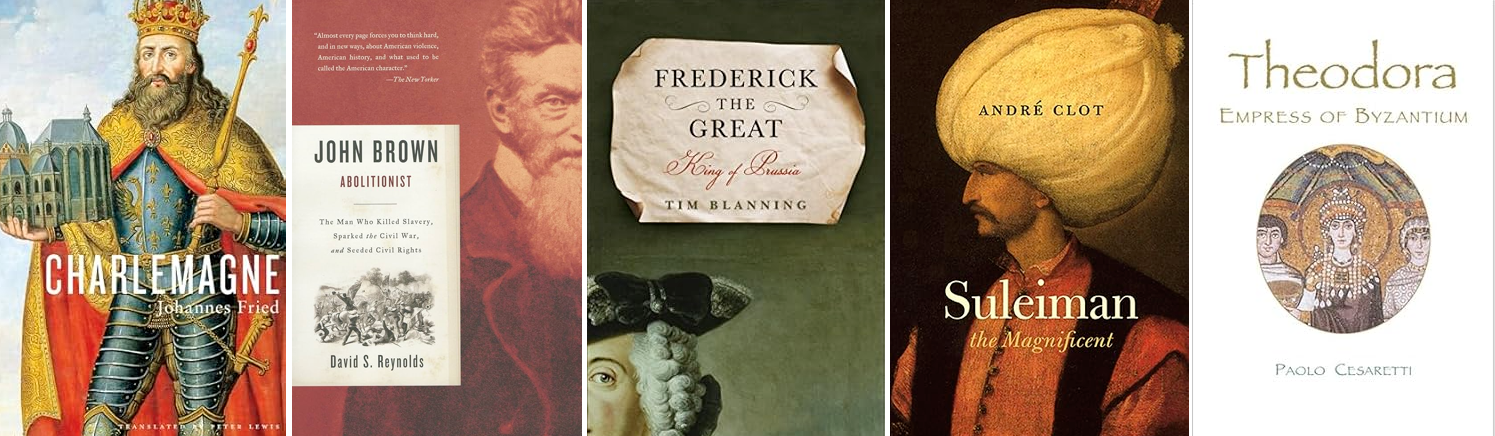
Even though this edition of Johannes Fried’s Charlemagne is a translation from the German, the magisterial work retains a conversational style that cuts through some of the potential turgidity of the underlying material (the only distracting choice is to render pagan Norse as “Normans,” which we conventionally reserve for the Christianized Danes who ruled Normandy). Fried admits candidly in the book’s preface that aspects of the narrative make recourse to imagination; Charlemagne was no Marcus Aurelius and we do not have access to the diaries of the king of the Franks. Instead, the author creates a composite character out of the extant historical materials available. Charlemagne was a man of his time, a Germanic warlord whose behavior and comportment would serve as the template for future Christian rulers, but nevertheless also a man of deep faith whose religion was sometimes at sharp variance with his actions. Living between 748 and 814 AD, Charlemagne is a liminal figure. Clearly no longer of Late Antiquity, he is also not quite medieval. In fact, Charlemagne and his world set the terms for what medieval was to become. His world was coarser and bloodier. The Germanic ruling elite of Western Europe after the fall of Rome emphasized martial values and skills more than their Roman predecessors, who might show their breeding and status through mastery of literature and the arts displayed in symposia; and yet the barbarous Frankish king deserves credit for accumulating a cadre of scholars at his court whose output would be crucial in preserving the learning of antiquity down to the present. In 800 AD, we see a new world beginning to take form, as the last filaments of Antiquity finally vanish into the ether.
Charlemagne’s choices and the empire he built, all left their mark over the centuries. Later German rulers looked to him as precedent, down to the Habsburgs who held the reins of the Holy Roman Empire into the 19th century. In contrast, John Brown, the violent American abolitionist whose raid on Harper’s Ferry was one of the last major events leading up to the Civil War, made an impact that played out, not over centuries, but over a handful of momentous years. David Reynolds’ John Brown, Abolitionist: The Man Who Killed Slavery, Sparked the Civil War, and Seeded Civil Rights was criticized when it was published in 2005, for portraying its subject too favorably. But judging by the mores that became the norm in academia after 2010, and especially leading up to 2020, had it been more recent, I can imagine reviewers complaining that it was too even-handed.
Brown was a stark figure, a terrorist of his age whose violence was vindicated by the course of the Civil War. Before his execution, he asserted that he was “quite certain that the crimes of this guilty land will never be purged away but with blood.” And so it was. But perhaps the most interesting aspect of John Brown, Abolitionist, is that a man who was sometimes asserted to be the last of the Puritans was in many ways part of a counter-cultural movement; the group that raided Harper’s Ferry included many freethinkers. If Charlemagne’s life was the beginning of a long fuse that led the Latin West toward the High Middle Ages, John Brown’s explosion onto the national scene in the 1850s, a radical tribune of Northern abolitionism, foretold broader social revolutions that would transform America in the 1860s.
Brown was a modest man whose revolutionary deeds of martyrdom made such an impact that he still enjoys name recognition even in our amnesiac age. Tim Blanning’s Frederick the Great: King of Prussia, on the other hand, spotlights a ruler less well known today, but who was a towering figure in his time. Frederick Hohenzollern, to become Frederick II, is probably unfairly eclipsed because his 46-year reign came just before the rise of an even more pivotal figure, Napoleon Bonaparte. But arguably the French republic’s rise, with its mobilization of the entire society to fight its wars, cannot be understood without recognizing what Prussia, the forerunner of what became Germany, had accomplished in the decades before the French Revolution. Though Napoleon’s military genius is well known, Frederick the Great’s Prussian state battled Austria, France, Russia, Sweden and the Holy Roman Empire during the Seven Years War, ultimately securing Prussia’s place as a great power in Europe.
A homosexual with a disdain for religion, Frederick was an aesthete whose court was suffused with the arts and music, all while he presided over one of the most militaristic of Europe’s states. Prussia in some ways reflects Europe in the 18th century: rationalistic, militaristic and culturally incredibly vibrant. Perhaps one of the realities that lingers most powerfully from Blanning’s narrative is that the equipoise between culture and martial valor evident in Frederick’s Francophilic court was broken by the Napoleonic Wars, and Bismarck’s “Iron Kingdom” of the 19th century would notably lack that previous Prussian aspiration toward refinement.
By coincidence, another monarch of refinement also reigned for a 46-year span, albeit nearly three centuries before Frederick: Suleiman the Magnificent, under whose aegis the Ottoman Empire reached its apogee. Andre Clot’s brisk 400-page treatment in Suleiman the Magnificent remains one of the more accessible English-language surveys of this potentate’s achievements. On diplomatic fronts, Suleiman continued his ancestors’ conquests in Europe, capturing Belgrade and leading his forces to the gates of Vienna, while it was under his direction that the Ottomans became a significant power in Asia more broadly, with fleets stationed as far afield as Sumatra. Under Suleiman, the Ottoman Empire was like a colossus astride three continents, Europe, Africa and Asia, but it was also to be the beginning of the end; the New World’s discovery had already begun turning civilization’s focus away from its Mediterranean core. Ottoman success up to the 16th century and Suleiman’s age had been predicated on their adoption of new military technologies, like firearms, but by the end of his reign, the Turkic state’s nimbleness was just a memory. The creeping torpor that would characterize the Ottomans in the next few centuries was the consequence of the reality that no ruler or general was going to match Suleiman, who cut a figure at once cruel and calculating and genuinely cultured. Like a black hole at the center of the galaxy, the Ottoman Empire’s existence is something that we all know of, but far too often fail to appreciate on its own terms. as a cultural, social and political reality that shaped life in western Islam for five centuries.
If Suleiman was born to the purple, so to speak, Paolo Cesaretti’s Theodora: Empress of Byzantium examines a figure who came from below and held her own for decades at the very heart of Late Roman society. Theodora, wife of Justinian the Great, who was known as the “last of the Romans,” had a colorful past as an actress and consort to various figures. Her relationship with Justinian began long before the latter’s uncle was elevated to become Emperor, clearing the path for his nephew to eventually ascend. Cesaretti depicts a woman who was in many ways firmer in how she wielded power than her husband; the histories generally depict Theodora as more stalwart in guarding the prerogatives of imperial power than her husband. Indeed, after her death, Justinian’s reign was seen to be more feckless, perhaps a reflection on the essential ballast that his wife has provided him in terms of advice. Although Western historians have traditionally painted an ambivalent portrait of the Empress, it is notable that Oriental Orthodox Churches, like that of Armenia, consider her a saint for her theological alignment with their position.
Thought
John Noble Wilford, Times Reporter Who Covered the Moon Landing, Dies at 92. I remember reading his articles in The New York Times and being shocked at how old he was. I highly recommend anyone with subscription access to The Times archives to (re)discover his old pieces; they’re a joy to read.
American higher education is adrift: From accommodations to admissions to grade inflation, colleges lack a sense of mission and purpose. Higher education currently has a major problem: it has become a “consumer product.” It shouldn’t really have been hard to foresee that while offering students easy courses and lots of amenities attracts “customers” in the short-term, it devalues degrees in the long-term. At some point, the faculty need to realize that with stewardship like this, they aren’t even going to be indefinitely guaranteed to be able to just “focus on their research.”
Rural America relies on foreign doctors. Trump’s visa fee shuts them out. One way to address this problem is to allow rural areas to “hollow out.” The reality is it is not clear that much of rural America, which was once demographically the bastion of family farms, is economically viable.
Two is already too many: Every hundred South Koreans today will have only six great-grandchildren between them. The rest of the world can learn from Korea’s catastrophe to avoid the same fate. Korean hyper-meritocracy wastes so much of everyone’s time competing in mass positional games that only a minority can ever win. And the rat-race doesn’t end with school; they continue to compete intensely at work to prove they are hard workers, regardless of the sector,, resulting in almost no semblance of a family life being feasible for working women in particular. South Koreans focus so much on winning in life that they disqualify themselves from even having time to perpetuate it.
Let That Skin In: Ancient DNA and the Evolution of Human Skin Colour: How migration and genetics shaped human pigmentation. David Piffer’s Substack has a lot of good content on ancient polygenic variation. This post shows that pigmentation is impacted both by ancestry and geography, and that Europeans have been getting paler over time.
How the Amber Trade Transformed Bronze Age Europe. A Dan Davis video about trade in Northern Europe 4,000 years ago. The late Bronze Age world of international trade that Eric Cline writes about in 1177 B.C.: The Year Civilization Collapsed also extended into Northern Europe.
Data
Revisiting the lineages of the Cohanim using data from next-generation sequencing. This preprint seems to confirm work from 25 years ago that the Cohen priestly lineages, passed through the male lineage, do share common ancestry 3,000 years ago.
Homo sapiens-specific evolution unveiled by ancient southern African genomes. The researchers sequenced 28 ancient genomes, with the oldest one dated to 10,200 years ago. They confirm that worldwide migration has even affected the San Bushmen in the last 1,000 years, and these Khoisan people have long had a sizable population in southern Africa on the order of tens of thousands, not much smaller than their current population of about 150,000.
Kinship-based social inequality in Bronze Age Europe. Early Indo-Europeans were patrilineal and highly stratified. We knew this from their mythology, but here they find DNA evidence of related males being buried near each other, and the persistence of certain high status lineages across the generations.
Ancient genomes give insight into 160,000 years of East Asian population dynamics and biological adaptation. This paper is a baby step towards understanding the trajectory of East Asian evolution in the same way we understand European evolution. Basically, to really probe a lot of questions you need many samples. It’s a numbers game.
My Two Cents
There’s still no free lunch, free subscribers; my most in-depth pieces for this Substack remain beyond the paywall. Most recently, I wrote about where we stand on Indo-Europeans and Indians when it comes to genetics and history.
First, Two Steppes forward, one step back: parsing our Indo-European past:
Ironically, the improbable connection between literary cultures half Eurasia’s breadth apart, from Nobel laureate Rabindranath Tagore’s vast and varied Bengali oeuvre (which includes both India and Bangladesh’s national anthems) to the lyrical language of Shakespeare’s timeless corpus, all owes to cultural transformations wrought by those first pre-literate nomadic barbarians. They poured forth out of Eurasia’s great grasslands, tall, dark and violent, plague speeding their emphatic arrival, burning down old civilizations and rewriting the continent’s genetic legacy overnight. How astonishing that such humble horsemen’s intervention would spawn globe-spanning cultural empires destined to leave their mark on the whole species, not just in our genes and the practices of patriarchy, but in millennia of myths and some of our most exalted, eternal, written works.
Then, The Waiting Game: Past, Present and Future of Indian Genomics:
The findings of 50,000 years of evolutionary history of India: Impact on health and disease variation may be as far as we can go with modern samples towards understanding the structure of the South Asian past. Nearly three thousand whole genomes from dozens of ethnic groups push the frontier of our understanding of the past appreciably, but thirty thousand whole genomes from hundreds of ethnicities would push it only marginally further. We’re well into the territory of diminishing returns at this point. There are only so many stories to be wrung from modern data alone. At some point, you just keep confirming and refining what you already knew. Again and again, geneticists have confirmed very high levels of Indian endogamy (and attendant low levels of within ethnic group genetic diversity) within a broader context of extremely high aggregate South Asian diversity. First, with the early genomic age’s coarse methods from just a few informative markers, and now with the fine-grained, data-rich methods possible since 2010 that scan the whole DNA sequence. Two facts remain indisputable: Indians have more overall genetic diversity than Europeans and East Asians, but greater inbreeding is also clearly written in their genomes. Global diversity, local homogeneity. More samples will simply reiterate this reality.
Unsupervised Learning Journal Club
A periodic feature for paying subscribers, the Unsupervised Learning Journal Club briskly reviews notable new papers or preprints. At the end of each edition, I invite subscribers to vote on papers/preprints for future editions.
Most recently, Immigrants of Imperial Rome: Pompeii’s genetic census of the doomed:
Pompeii and Herculaneum’s destruction vividly preserved certain evocative aspects of a moment in the life of the early, vigorous, cosmopolitan Roman Empire. The pyroclastic surges preserved details of Herculaneum’s economic activity, carbonizing freshly baked bread, but also preserving things like an entire private library of fragile papyrus scrolls and sets of ornate chairs. That latter fact attests to an artisan class in a united empire producing highly specialized goods that cargo vessels would ferry around the “Roman sea.”
Meanwhile, this arbitrary genetic sample of citizens reveals that many Pompeiians were newcomers on a historical time scale of centuries, while their style of dress indicates that they were well integrated. The empire of our snapshot emerges as culturally assimilative, just as the texts would have us believe. The citizens who died that day in Pompeii leaving precious genetic traces for us to study appear to largely descend from newcomers to the Italian peninsula, whether highborn or low. A notable legacy of the Roman Empire’s fall is that this genetic and cultural matrix seems to have faded with urban areas’ collapse, so that modern Italians living in Mt. Vesuvius’ shadow today actually share stronger genetic connections to prehistoric Italians than to those citizens of the high Empire whose frozen final moments speak to us with such human immediacy across the ages.
Previous editions:
Wealth, war and worse: plague’s ubiquity across millennia of human conquest
Where Queens Ruled: ancient DNA confirms legendary Matrilineal Celts were no exception
Eternally Illyrian: How Albanians resisted Rome and outlasted a Slavic onslaught
Homo with a side of sapiens: the brainy silent partner we co-opted 300,000 years ago
Brave new human: counting up the de novo mutations you alone carry
Genghis Khan, the Golden Horde and an 842-year-old paternity test
Ghost Population in the Machine: AI finds Out-of-Africa plot twists in Papuan DNA
For free subscribers: a sense of the format from my coverage of two favorite papers last year:
Discussion
All my podcasts go ungated two weeks after their Substack release. So I encourage subscribers on the free plan who’d like to automatically get them to subscribe to that podcast stream (Apple, Stitcher, and Spotify). If you want to listen on YouTube, please subscribe.
Here are podcasts since the last Time Well Spent:
Vishal Ganesan and Anang Mittal: American Hinduism out of Indian Hinduism
John Hawks and Chris Stringer: Neanderthals, Denisovans and humans, oh my!
ICYMI
My domain also has all my links and updates: https://www.razib.com, including links to the few different podcasts I’ve contributed to or run, my total RSS feed, and my more mainstream or print articles when I remember to post them, my Twitter, the occasional guest appearance, etc.
DM me
Facebook message me
Some of my past pieces for Palladium Magazine, The New York Times, Slate, Quillette and Nautilus.
Over to you
Comments are open to all for this post, so if you have more reading/listening suggestions or tips on who I should be talking to or what you’ve been waiting to read about, put them here.
2) RE: John Brown. He has an interesting family connection with US Grant, who has a good claim to being the white man who contributed most to the destruction of slavery in the US. When young, Grant's father, Owen, worked on the farm of John Brown's father, and knew the latter as a boy. According to Claude, Grant's "father regarded Brown as a person of great moral courage and purity of character, though also considered him a fanatic and extremist. Grant shared his father's mixed assessment. He considered Brown's attempt to overthrow slavery with fewer than twenty men at Harper's Ferry to be the act of an insane man."
Clot's biography of Suleiman the Magnificent is indeed enjoyable and accessible, but the definitive biography in English is now "Peerless among Princes: The Life and Times of Sultan Süleyman" by Kaya Şahin, published in 2023. Scholarly, but also very readable and impressively sourced.
Though Süleyman's successor Selim II was less-than-impressive, he did have enough sense to let the great Grand Vizier Sokullu Mehmed continue in his job. (Lepanto occurred on one of few occasions when Sokullu was overruled). The real trouble came when Selim's even less impressive successor Murad III destabilized the position of the grand vizierate and left it prey to factional infighting.
Nowadays many Ottoman scholars like to claim that the empire underwent a period of "transition" rather than "decline" during the 17th century, and even claim that the Janissary revolts were signs of supposed democratization. I think that's going too far (when an empire that can't defend its domains that sounds like decline!), but there is something to be said for the idea that the Ottoman's troubles stemmed more from structural issues than the variable quality of its rulers (some of whom were very capable, like the Köprülü viziers, or the short-lived Murad IV).